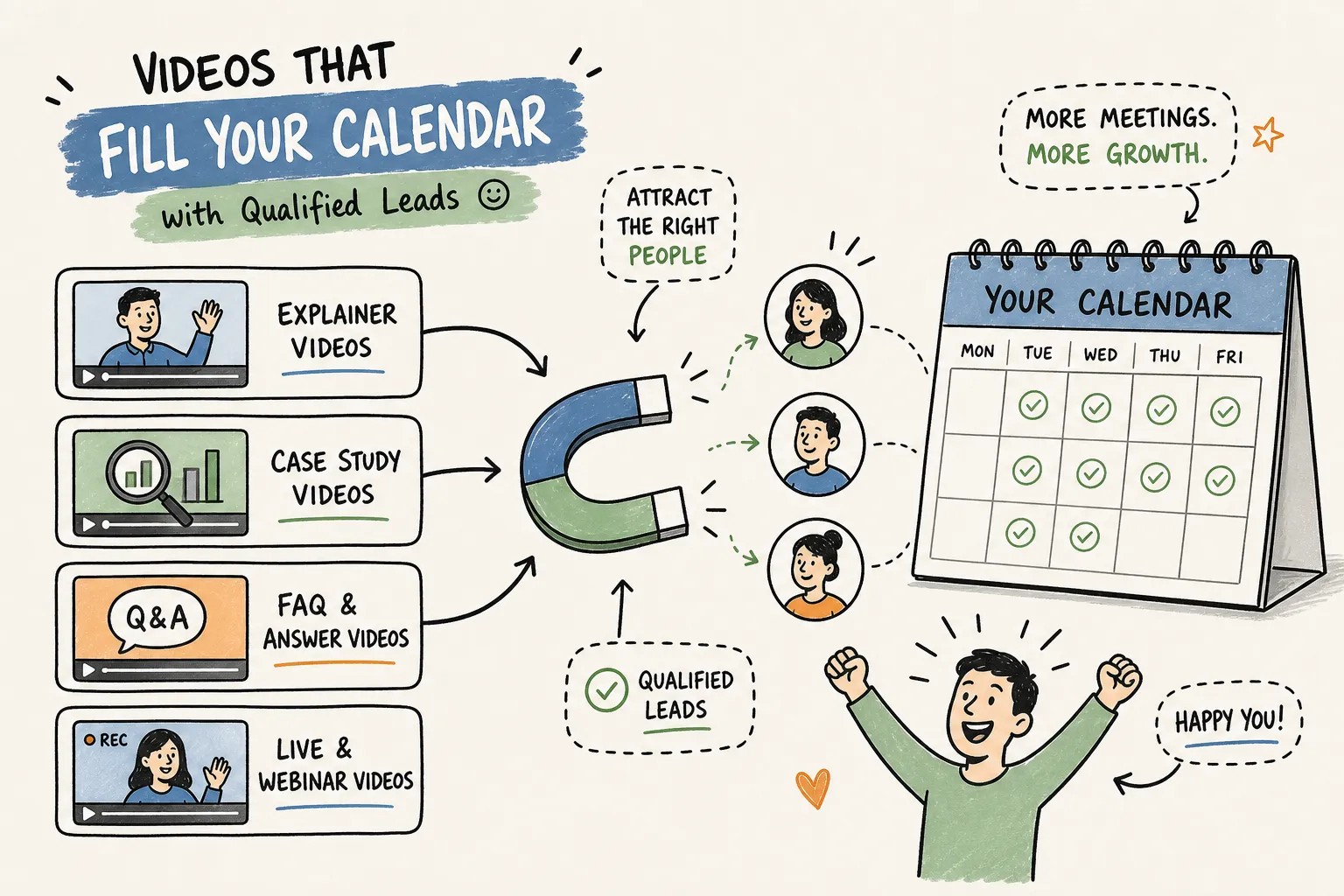
Most service business owners pick video topics that feel comfortable to shoot instead of topics that move a real buyer closer to booking. You end up with a folder of decent-looking clips and a calendar that never fills.
Views don't pay your bills. Booked calls do. The gap between video that gets watched and video that gets you hired comes down to one thing: does the video match where that specific buyer sits in their decision? Match the video to the stage, and the content does the selling before your phone ever rings.
Here are the four video types we build into every client's monthly plan, what job each one does, and how we sequence them so the system keeps working month after month instead of stalling out after one good post.
A stranger gets curious. A curious person starts comparing options. Someone comparing options narrows down to two or three providers. Someone who's narrowed it down books. Your video content needs to show up at each of those points, but most businesses only make one kind of video, usually a top-of-funnel awareness clip, then wonder why the views never turn into consultations.
A qualified lead has a real problem, a real budget, and real intent to act soon. The videos below filter for that combination instead of just chasing attention. Each one has a specific job in your pipeline.
By the time a prospect is deciding, they've stopped asking what your company does. They're asking whether it'll work for them. A testimonial video answers that with proof instead of another claim from you, and that's why it tends to be one of the highest-converting formats we produce for clients.
The testimonials that convert aren't the ones with generic praise. They name a specific problem, a specific number, and a client the viewer can picture themselves as. "They helped us grow" does almost nothing. "We went from three inbound calls a week to twelve in sixty days" gets remembered. Wyzowl's video marketing research backs this up. VWO testing has shown testimonial videos lifting sales page conversions by as much as 34 percent, and testimonials remain one of the most widely used formats among video marketers for good reason.
Structure the story simply: the problem before hiring you, the hesitation they had, the specific result, and what's different now. Keep social cuts to 30-60 seconds. Give the full version two to three minutes on a landing page or YouTube if the story earns it.
Pair every testimonial with a direct, bottom-of-funnel ask. "Book a call" or "Schedule your consultation." The viewer just watched someone else succeed. Don't soften the next step.
A buyer in the middle of evaluating you has questions they don't feel comfortable asking on a sales call yet. They want your process, your pricing range, and your limits before they'll agree to talk. Answer those questions publicly and you build trust before the phone ever rings.
Skip the easy questions. "How long does a project take" is fine, but the FAQ video that does the most work is the one that answers "who is this not right for." That question pre-qualifies your audience and tells them you're confident enough to turn away a bad fit. Anyone who watches that video and still reaches out is worth your time.
One question per video, 60-90 seconds for your site or trimmed to 30-60 for social. A series of short, focused clips beats one long compilation, each one is easier to find, easier to rewatch, and easier to repurpose into a social clip or a follow-up email. Pair FAQ videos with a mid-funnel ask like a service guide download or a free discovery call.
Strong FAQ topics for a video production business look like pricing, timeline, what onboarding looks like, and who you're the right fit for. The more directly a video answers a hesitation your buyer already has, the more it does the filtering for you.
Buyers researching a service business often can't picture what working with you actually looks like, especially when the outcome is intangible, a better strategy, a stronger brand, a resolved problem. Process videos remove that uncertainty by showing the real thing.
This covers a wide range: how you approach a new project, what a typical engagement looks like, what onboarding involves, real behind-the-scenes footage of you at work. On Instagram Reels and YouTube Shorts, authentic process content beats polished brand spots, particularly for local service businesses where trust decides the sale before price does.
The effect compounds. A prospect who's already watched five or six process videos from you shows up to the first call already understanding how you work. They ask fewer basic questions and hesitate less, not because you dropped your price, but because you did the relationship-building before they ever picked up the phone.
An offer explainer isn't a demo. It's a plain, conversational walkthrough of what a prospect gets, what the engagement looks like, who it's built for, and what happens right after they reach out. This works best once a buyer already knows they have the problem, the video just clears up what's left standing between them and booking.
For a service business, this sounds like "here's what's included in our monthly package," "here's what happens on your first call with us," or "here's who gets the best results from this." You're not selling at this point. You're removing the last bit of friction.
Where you place it matters. An offer explainer above the fold on a service page with one clear button, "book my consultation" or "start now", converts better than a page that makes someone hunt for a contact form. Cut the form. Direct beats indirect at this stage.
One good video won't build you a pipeline. A repeatable system will, one that puts the right video in front of the right buyer every month instead of producing one testimonial, posting it, and losing momentum.
Here's the four-week structure we run for clients through our Tidal Video Framework:
Week one is a process or educational video to build early awareness. Week two is an FAQ video that moves evaluators forward. Week three is a testimonial or short case study that builds trust with serious buyers. Week four is an offer explainer, or a flagship case study, aimed at the people ready to book.
Each core video gets cut into two or three short-form pieces for social and a version for email follow-up, so one shoot covers a month of content instead of starting from scratch every week. What performs feeds directly into the next month's topics, so the system gets sharper over time instead of resetting.
We run this exact structure for our clients: one new proof piece each month, two or three FAQ or process videos, and one refreshed offer explainer tied to whatever you're promoting that month. Strategy, scripting, production, and posting all happen under one roof, so the calendar keeps filling instead of spiking once and going quiet. Check out our case studies to see what that's looked like for other businesses.
It's which videos, in what order. Testimonials close the trust gap at the decision. FAQ videos filter out the wrong buyers during evaluation. Process videos build credibility before anyone calls you. Offer explainers make booking the obvious next move.
Most service business owners don't have the time to build and run this system while also running the business. That's the gap we built the Tidal Video Framework to close. Start with one video from each category, stick with it for 90 days, and watch what happens to your calendar.
We build and manage this exact system for clients every month, strategy, production, and posting included.
Book a Call