Most businesses treat video ads and organic content like competing budget lines. Fund one, cut the other. That's a false choice, and it usually means underinvesting in both, which is worse than picking either one on its own.
We run both channels for clients across a range of industries, and the pattern holds every time. The businesses that grow figure out what each channel does well and build a system around it, rather than picking a side and hoping it carries the whole load.
Paid video rents reach from a platform's ad system. You set an audience and a budget, the platform serves your video to people who've never heard of you, and the reach stops the moment the budget does. It's a tap you turn on and off.
Running ads still leaves something behind after the budget runs out: a retargeting audience, lookalike pools, and performance data that outlives the campaign itself.
Organic content earns reach through the algorithm instead. It goes to your followers first, then expands based on watch time, shares, and saves. There's no guaranteed floor on reach, and no spend-based shutoff switch either. A strong organic video keeps pulling views and inbound traffic for months after you post it, without costing another dollar.
The businesses that default hard to one channel usually mix these two things up. Paid buys reach on demand. Organic builds a distribution asset that keeps paying out long after you've stopped actively working on it.
CPMs move constantly, and every benchmark tracker reports a slightly different number, but the shape holds across most of them. TikTok tends to run cheapest, somewhere in the mid to high single digits per thousand impressions. Instagram and Facebook usually land a bit higher. YouTube typically costs more per impression than either, and that premium tracks with something real: YouTube viewers tend to watch longer and show stronger purchase intent, so you're often paying more to reach people who are paying closer attention.
One number a few different trackers agree on: TikTok's in-feed cost per click sits right around a dollar, which is part of why it's the easiest platform to test paid video on without committing serious budget.
One ad impression doesn't build a relationship. Organic content posted consistently over months creates familiarity a single paid campaign rarely matches at the same cost. A prospect who's watched several of your organic videos already knows how you think and what you stand for before they ever fill out a form. For anything high-ticket, a home renovation company, a specialist medical practice, that familiarity often matters more than any targeting parameter paid media can offer. A ten-thousand-dollar contractor gets hired because the prospect already feels like they know them, built from months of showing up in their feed rather than a single ad.
A well-made organic video keeps working long after you post it. Educational and FAQ-style content especially, since it keeps answering the same question every time someone new finds it. That's a compounding asset. Paid reach stops the moment spend does, though the audience data it generated along the way still has value for whatever you run next.
The best organic content doubles as free market research. A video that performs organically has already proven people respond to it, before you spend a dollar putting it in front of strangers. TikTok's own numbers back this up: in a Nielsen analysis of 780 direct-response campaigns, ads built from boosted organic posts ran at $14.62 cost per acquisition against $23.18 for ads built from scratch, and converted at 2.6% against 1.8%. Scaling something that already works beats guessing at something new.
Organic reaches people already connected to you somehow: your followers, their followers, people already searching your niche. Paid reaches total strangers who'd never find you any other way. If you're trying to grow past your current referral network, paid is the only lever that puts your content in front of people who don't know you exist yet.
Product launches and event-driven campaigns need reach on a deadline, and organic can't promise that. Paid scales up within days against a defined audience, which is the whole appeal when timing matters more than cost efficiency. Video ad conversion rates on platforms like YouTube tend to sit in the low single digits, with cost per acquisition ranging anywhere from twenty to over a hundred dollars depending on the industry and offer. Wide range, but it's a number you can plan a launch budget against. Organic doesn't give you that.
Retargeting people who already watched your organic content tends to outperform cold paid spend by a wide margin. Someone who sat through 75% of an organic video is a warm lead with demonstrated interest. Serving that person a direct offer converts at a different rate than the same ad shown cold. This is the point where the two channels start compounding each other instead of competing.
Split production and media buying across two vendors and the creative brief rarely lines up. One team optimizes for how the video looks, the other for how it converts, and the gap between those two goals is where a campaign quietly underperforms with no clear diagnosis.
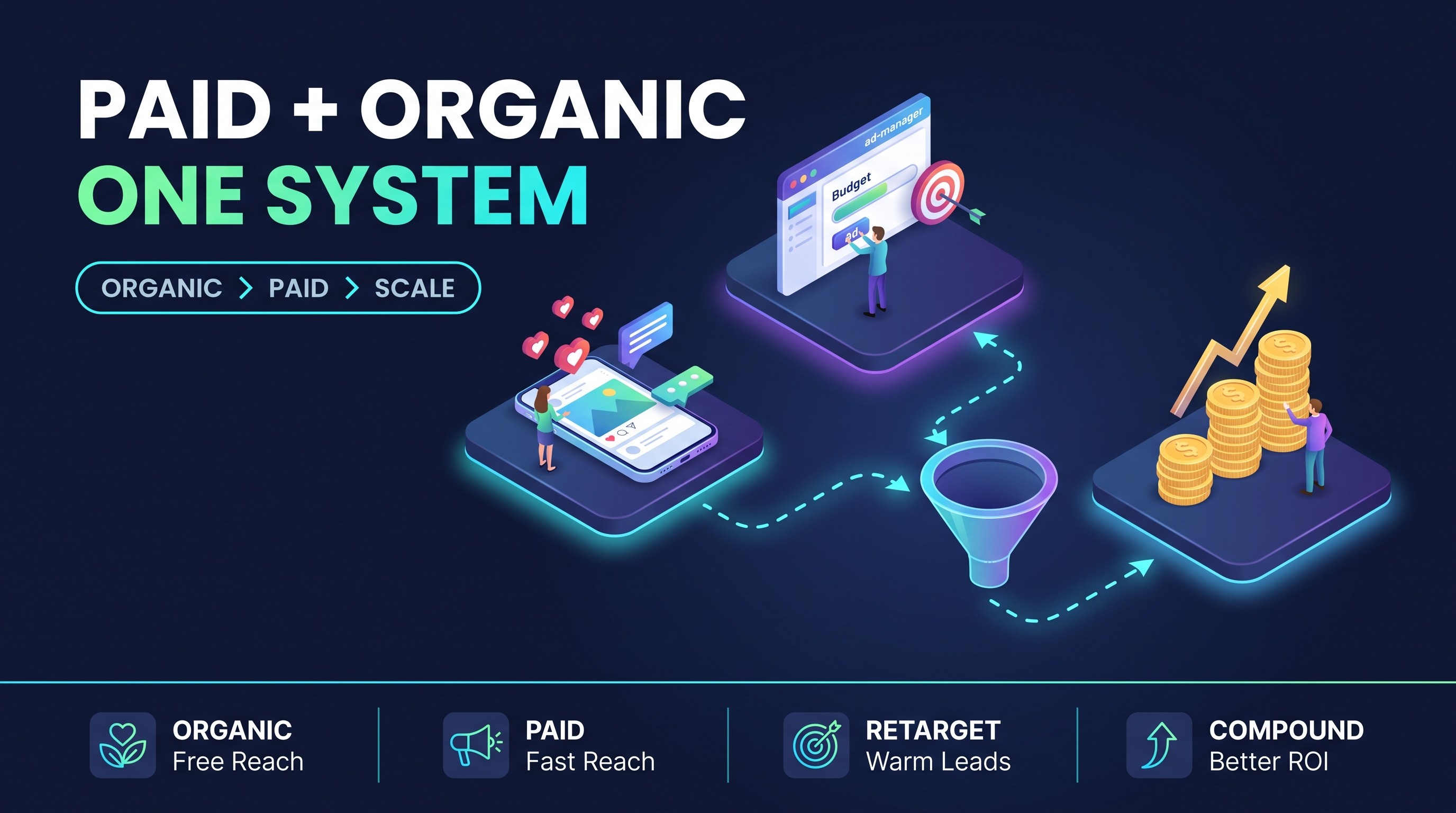
Build organic and paid from the same strategy and they start reinforcing each other. Organic builds trust and warms up an audience at low ongoing cost. Paid scales whatever's already proven to work and retargets the people who engaged. Better organic performance means a better retargeting pool, which means more efficient paid spend, which funds more content. The cycle compounds month over month instead of resetting.
At Tidal Media Co., that's how we structure client work: one monthly workflow covering scripting, production, organic posting, paid distribution, and analytics under one roof. What performs each month feeds directly into the next month's plan, and there's no coordination gap between the people making the video and the people buying the media, because they're the same team.
Start with two to four core videos a month, more or less depending on your industry and how fast you can produce. Post organically first and give it two to four weeks to show you what's working. Take whatever performed best and either boost it directly or rebuild it into a proper paid ad with a clear offer and a clear next step. Layer a standing retargeting campaign underneath, running continuously against your organic viewers, and the system starts building on itself instead of starting from zero every month.
The real question is what you need right now, not whether to pick paid or organic. Cold reach on a deadline, paid is the faster path. Long-term trust with an audience that already half-knows you, organic does that job more efficiently than any ad spend. Most businesses that compound results run both from the same plan instead of picking a side.
We build that exact system for clients: production and paid distribution under one roof, month over month. Check out our case studies to see what that's looked like for other businesses, or reach out and we'll map out what the system looks like for yours.
We plan, shoot, post, and run paid distribution from a single monthly workflow, no coordination gap between production and media buying.
Book a Call