Ask five Southern California production companies for a quote and the numbers you get back can span a few hundred dollars to six figures, all for something that sounds like the same request. The gap comes down to what drives the price, not dishonesty on anyone's part.
We hear some version of this question from nearly every new client, so here's the honest version: real 2026 numbers, broken out by video type, crew cost, and shoot scope.
Most Southern California production companies work within three rough tiers, and knowing them helps you make sense of quotes when they land in your inbox. Budget-tier work means a one- or two-person crew, a basic camera package, and light pre-production. Mid-range adds a dedicated director of photography, proper lighting, a sound mixer, and a scripted process before the shoot. Premium work means a full crew, high-end cameras, location scouting, professional talent, and post-production with color grading and sound design. These tiers map directly to what shows up in your final deliverable.
LA sets the pricing baseline for the whole region. Crew who regularly work the LA market price at LA rates whether you're shooting in Temecula, San Diego, or Orange County, and equipment houses follow the same logic. Inland Empire shoots might save a little on location fees and logistics, but day rates for crew tend to stay close to the LA floor. If a company calls itself SoCal-based, that's usually the rate card you're working with.
Agency-produced social clips run $1,500 to $5,000 apiece, with volume packages landing between $1,000 and $8,000 depending on how many deliverables come out of one shoot day. Solo freelance work can hit a $500 floor, but that usually means one person handling camera, audio, and editing, and it shows in the final cut. Per-clip pricing adds up fast next to a shoot day built to produce several assets at once.
A polished 60- to 90-second brand film runs $5,000 to $15,000 at the mid-range level, and $15,000 to $45,000 for a full hero film with cutdowns and paid-social versions pulled from the same shoot. A single-camera talking-head video and a two-day cinematic shoot with original music and color grading are not the same product, and the price gap follows from that.
Standard corporate videos, internal communications, recruiting, training, typically run $3,500 to $15,000, with multi-location or higher-polish work pushing into $15,000 to $50,000. Short-form ad creative for Meta or Google lands between $1,200 and $8,000 per deliverable. A properly produced 30-second TV-grade commercial is its own category: expect $25,000 to $80,000, with national brand campaigns sometimes clearing $100,000.
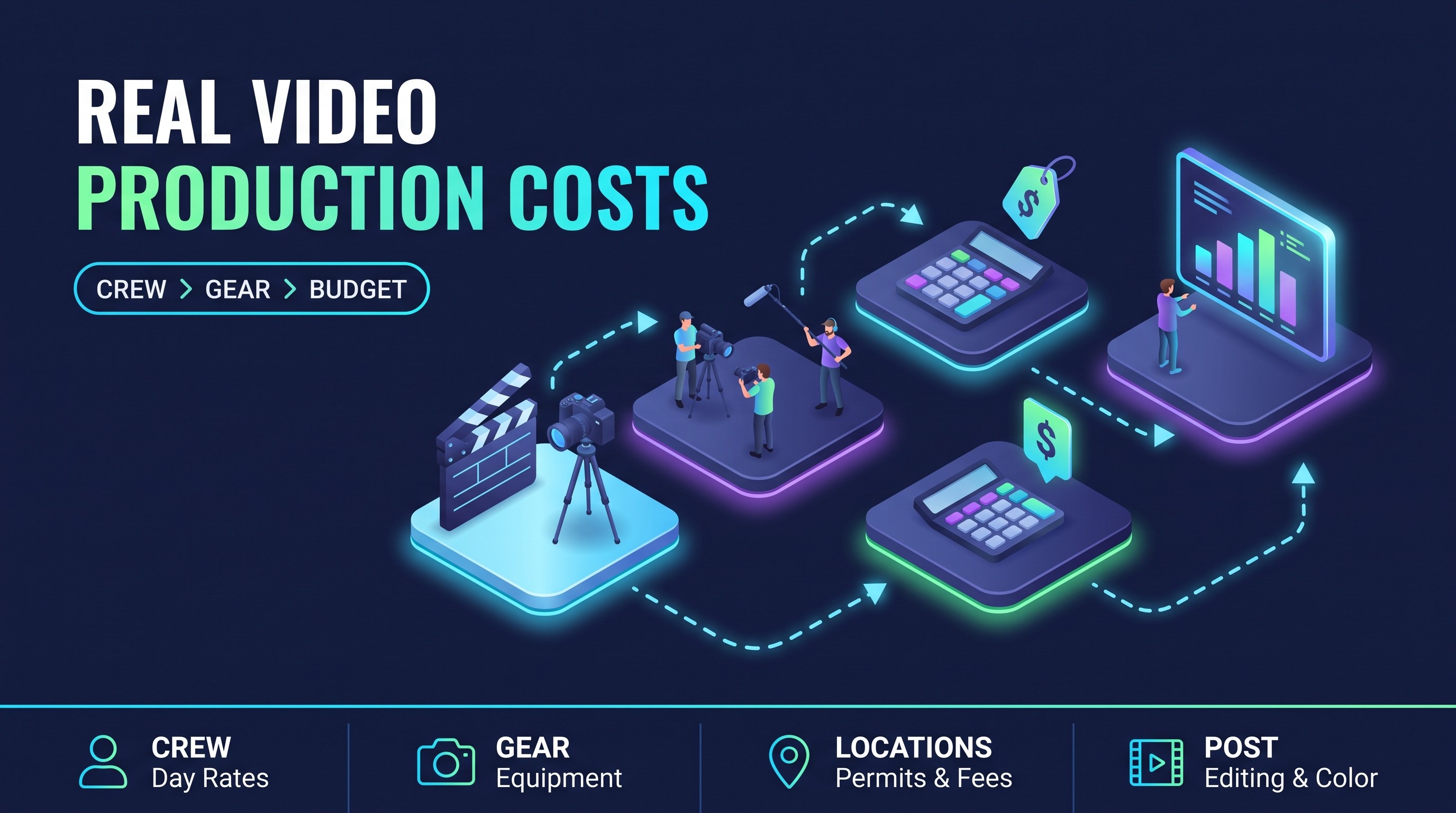
Crew rates vary a lot depending on who you ask, but a reasonable planning range for non-union Southern California crew in 2026 looks like this: a director of photography runs $800 to $2,000 a day depending on experience, a gaffer $400 to $1,200, a sound mixer $400 to $900, an editor $500 to $1,500 per project, and a colorist $700 to $2,500 depending on the tier of work. Union crew and top-tier commercial productions run higher than any of these ranges.
Equipment, locations, permits, and insurance stack on top of crew. A professional camera package runs anywhere from a few hundred dollars to over a thousand per day depending on the system. Location fees range from $500 to $2,500 a day for a simple space, more for a built studio. In the city of Los Angeles, FilmLA's standard commercial permit runs $931, or $350 under the Low Impact program for small productions with fewer than 30 people, three days, and three locations, plus a notification fee of $156 to $250 per location. Production insurance for a single day commonly runs $500 to $1,500. A detailed quote breaks every one of these out. If yours doesn't, ask why.
Post-production is the line that surprises most clients. Editing, color, sound design, motion graphics, and revisions get billed on top of the shoot-day cost, and for a brand film they can end up as a large share of the total budget. Comparing quotes on the shoot-day number alone is how people end up picking the cheaper bid and then paying the difference in change orders. Get the post-production line item before you compare totals.
A solid single-day professional shoot in Southern California typically runs $6,000 to $25,000 depending on crew size and production level. In Los Angeles specifically, branded content from one shoot day commonly lands at $12,000 to $25,000, covering pre-production, shoot-day crew, equipment, and a basic edit, not a fully finished piece with color, sound, and revisions. A single day carries the highest cost per day, because every fixed pre-production expense compresses into one billing cycle.
Add a second day and the cost goes up, but not by a full day's rate, since the fixed pre-production cost already got paid on day one. Multi-location work adds roughly $1,500 to $5,000 per additional location for travel and logistics. The practical upshot: more shoot days raise the total but lower the cost per deliverable, which is why businesses that plan a shoot to yield multiple assets tend to get more for their money than ones booking a separate single-day shoot for every video.
Hire a freelance videographer, a separate editor, and an ad agency to run your campaigns, and you're paying three markups and managing three relationships that never talk to each other. Creative and ad strategy drift apart because nobody on either team is looking at both.
We run scripting, production, editing, posting, ad management, and analytics as one monthly engagement instead of billing each piece separately, so a cut-down version of your brand film for ads is already part of the plan rather than a surprise invoice. You can see our current packages on the pricing page.
A bundled monthly system makes the most sense when the goal is consistent output, not a single video. One shoot produces diminishing returns within a few weeks as attention moves on. A system that produces new creative on a regular cadence, feeds it into paid distribution, and adjusts based on performance compounds instead. That's the difference between video as a marketing asset and video as a one-time expense.
Vendors can't quote accurately off a vague ask. Before you reach out, write down your video type, the platform it's for, roughly how long it needs to be, how many shoot days you expect, whether you need on-screen talent, and your timeline. The more specific the brief, the closer the first quote lands to the final invoice. A one-line email asking "how much for a brand video" almost always gets back a range too wide to plan around, because an incomplete brief forces the vendor to guess at scope.
Ask directly what happens if you need an extra revision round, whether color grading and sound design are included in the number you were quoted, and whether there's a usage fee for on-screen talent. A vendor who's being straight with you answers those questions immediately. One who says "we'll figure it out later" is a billing risk waiting to happen.
Measure what the video does after it ships. For paid creative, track cost-per-lead and cost-per-acquisition before and after the new video goes live. For brand films, watch organic traffic, time on site, and direct inquiries in the 60 to 90 days after publish. On Meta, a healthy video campaign in 2026 typically lands somewhere in the 2x to 4x ROAS range, though your own historical numbers matter more than any industry average. Without a plan to measure results, the production budget stays a cost instead of becoming a decision.
Southern California video production costs what it costs because real crew, real equipment, and real post-production carry real price tags. The businesses that get the most out of their budget understand what they're buying, write a specific brief, and work with a team that treats production as part of a bigger system instead of a one-off deliverable. Spending the most rarely has much to do with it.
Whether you're pricing a single brand film or thinking about a full monthly system, use these numbers to ask sharper questions and read a quote for what it includes. Check out our case studies to see what a bundled system looks like in practice, or reach out and we'll price out what your project needs.
Tell us what you're trying to make and we'll price it out honestly, no vague ranges, no surprise invoices.
Book a Call