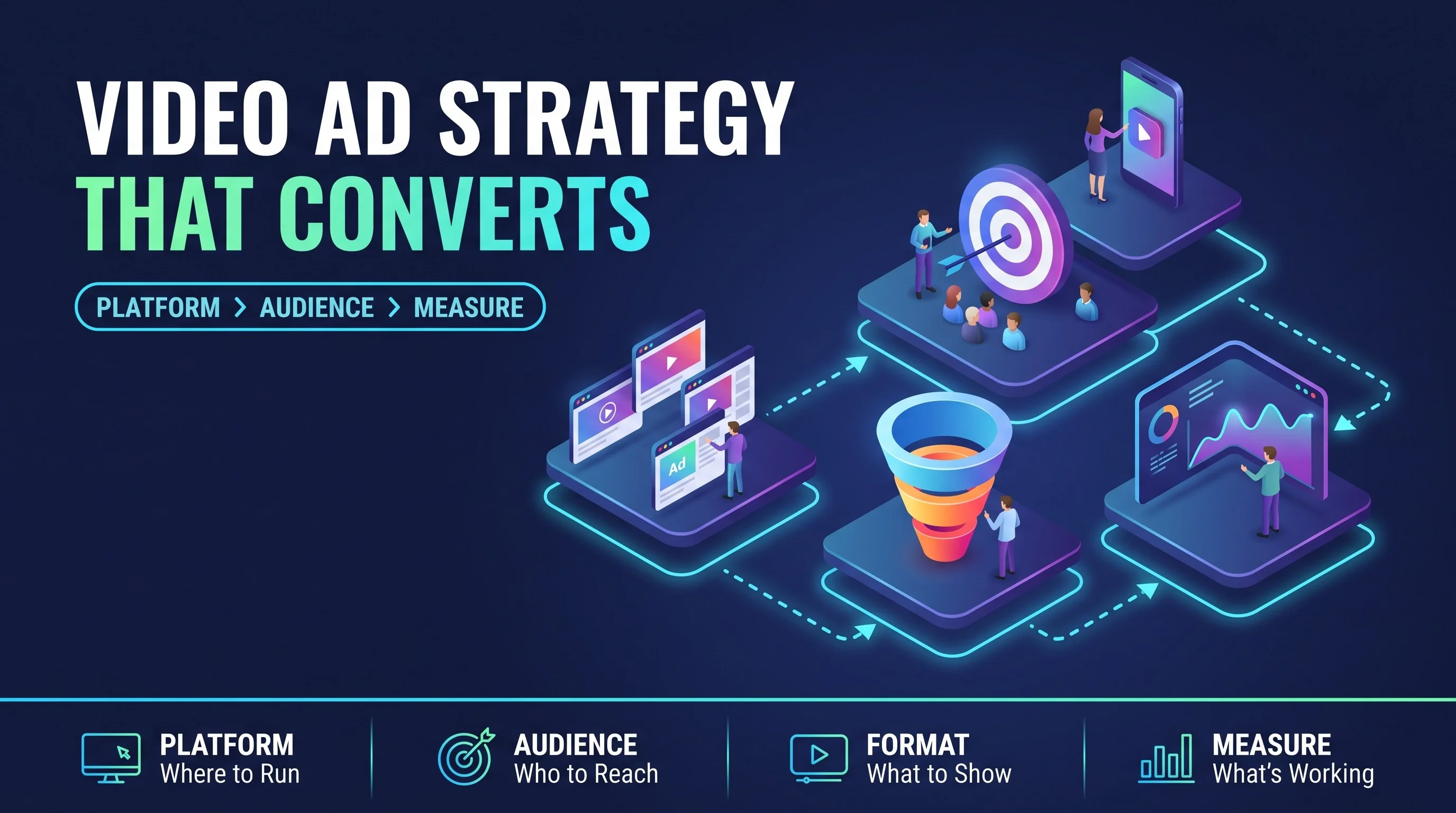
Most video advertising fails before a dollar gets spent. The creative gets built first and the strategy gets figured out after, so you end up with a polished video aimed at the wrong audience on the wrong platform with the wrong message. The order of operations breaks it, not the production quality.
A plan that converts gets built backward: where the video will run and who's watching get decided first, and the creative approach follows from that, before anyone picks up a camera. We structure every client engagement around production and paid distribution as one connected system instead of two separate workstreams, and it consistently performs better than splitting them. Here's how we build that: platform, audience, format, budget, and measurement, in that order.
Platform selection is a strategic call, not a preference. It depends on where your audience sits in the buying journey and what intent signal each platform captures. Picking Meta because it's familiar, or YouTube because it sounds prestigious, burns budget that should be working harder.
Meta gives you the largest targetable pool and the most mature retargeting infrastructure in paid social. It's the strongest starting point for a service business running awareness and retargeting off a shared budget, especially when you're warming up an audience that doesn't know your brand yet. Since most of the feed moves on scroll, a video needs to earn attention in the first two to three seconds or it never gets watched.
YouTube sits where search intent meets video engagement. In-stream ads reach people already watching related content, and conversion-focused campaigns can be built to drive leads directly. It makes the most sense for high-ticket services, longer decision cycles, and anything where showing beats telling, a renovation company walking through a real project, a specialist explaining a procedure. If you're in a low-search-volume niche or running a tight local budget, YouTube often isn't the right place to start.
LinkedIn costs more, typically somewhere in the $30 to $50 CPM range against Meta's $12 to $25 for comparable B2B targeting. What that premium buys is firmographic precision: industry, company size, job title, seniority. You're reaching an actual decision-maker instead of a broad interest-based audience that might include one. Thought-leadership clips and case study formats tend to perform best there. The higher cost only makes sense when the lifetime value of a converted lead justifies the higher CPA, which rules LinkedIn out for a lot of local service businesses and makes it a real option for the ones selling something bigger-ticket.
Audience targeting works less like a numbers game and more like matching the right video to the right audience at the right temperature, and the same three-tier structure applies whether you're running Meta, Google, or LinkedIn.
Cold audiences have no history with your brand, so leading with your solution wastes the impression. Open with a problem the viewer already recognizes instead. On Meta, lookalike audiences built from your best customers are the standard prospecting tool. On Google and YouTube, in-market segments and keyword targeting reach people already searching related topics.
Anyone who watched half of a previous video, visited your site, or engaged with your content counts as warm. They already know you exist, so retargeting creative can run shorter, more direct, and offer-led. Meta builds this through video engagement audiences, Google through remarketing tags and customer match lists. Don't serve cold-audience creative to a warm audience. It wastes a relationship you already built.
Longer consideration cycles change how long you hold an audience in a retargeting pool. Someone who sees a B2B or high-ticket service ad today might not be ready to buy for 60 days or more, so a 90-day retargeting window makes sense there. A retail or everyday-service audience usually decides within hours or days of a retargeting ad, and holding that pool past 30 days often just means showing stale creative to someone who already moved on.
Treating every video as interchangeable is one of the most common budget leaks in paid video. A 90-second brand story and a 15-second offer-led ad don't do the same job, and running the wrong one at the wrong stage shows up as wasted spend that's hard to trace back to the cause.
For cold prospecting, short wins. Six-second bumper ads work well for reinforcement in high-reach YouTube campaigns. On Meta and Instagram, vertical video fills the screen in Reels and Stories, and the metric that matters here is reach and completion rate, not clicks.
Mid-funnel viewers need enough time to understand what makes the offer worth their attention. A 15- to 30-second cut works in standard feed placements. For a high-ticket service or anything with a learning curve, 30 to 60 seconds gives room to show proof without losing the viewer. YouTube's median view rate for in-stream ads runs around 30%, with strong campaigns clearing 35% to 45%, which means a well-built 45-second demo can hold a real share of your audience through the whole message.
Retargeting ads pushing a warm audience to book a call or start a trial work best short and direct, six to fifteen seconds. The exception is a real objection: if price, commitment, or fit is the common hesitation, a 30- to 45-second video that names and resolves it will outperform a blunt, short CTA. Let the friction level decide the format, not the other way around.
Most businesses either dump everything into awareness or everything into conversion, then wonder why cost-per-lead is high. Neither works consistently on its own. A budget split by funnel stage changes the trajectory over time.
For B2B or high-ticket local service campaigns, a reasonable starting split runs 40 to 60% awareness, 25 to 40% consideration, and 15 to 25% conversion, since these buyers need several touchpoints before they'll book a call or fill out a form. Push conversion spend too early, before there's enough awareness volume, and cost-per-acquisition climbs while the audience pool runs dry fast.
Everyday consumer campaigns can weight conversion more heavily, something like 20 to 30% awareness, 20 to 30% consideration, and 40 to 60% conversion or retargeting, since direct-response video on Meta or YouTube can generate a lead the same day the impression runs. Keep enough awareness spend flowing to feed the retargeting pool. Let it shrink and retargeting performance drops right along with it.
This is where most plans fall apart. A company hires a production team to make a video, then hands the finished file to whoever's running the ads, and that person has to retrofit it into placements it was never built for. No hook structure, no vertical crop, no CTA visible in the first three seconds. The footage looks great and does nothing.
Aspect ratio, hook structure, pacing, on-screen text, CTA placement, every one of those decisions should get made with the platform and the audience in mind before production starts, not after. A video built for YouTube in-stream looks and performs differently than one built for Meta Reels, even carrying the identical message. Retrofitting creative after the fact is expensive and rarely closes the gap.
We script, produce, and run video ad campaigns as one connected system instead of handing off a finished file and stepping away. Creative decisions get made with performance data in the room from the start, which closes the gap between what gets produced and what converts. For production costs and timelines, we broke that down in detail in our guide to what video production costs.
Video ads influence decisions that don't always show up as a click. Measure a video campaign the way you'd measure a search campaign and you'll undervalue it every time, then pull budget away from something that was working.
Click-through attribution misses most of video's real impact, since most viewers never click. They watch, form an impression, and convert later through search or direct traffic instead. View-through attribution catches more of that by crediting a conversion to anyone who saw the ad within a set window. Treat both as directional. They tell you where to look, not exactly what caused the result.
A lift test splits your audience into an exposed group and a holdout, then compares conversion rates between the two. The gap between them is your real, incremental lift, and Meta, Google, and LinkedIn all support some version of this. Running one every quarter gives you actual causal data instead of a guess, which is the only way to answer the question that matters: would these people have converted anyway, without the ad?
Check completion rates, hook retention, and CPM by placement every week. A video sitting below a 25% completion rate has a hook problem, and no amount of landing page work fixes that. Monthly, compare cost-per-lead and cost-per-acquisition across funnel stages, shift budget based on what the data shows, and rotate any ad that's run more than four to six weeks without a refresh. Creative fatigue shows up as a rising CPM before it shows up as a conversion drop, so watch for the earlier signal.
None of this is a one-time setup. Platform choice decides where the budget goes. Audience temperature decides the messaging and the sequencing. Format and length follow the funnel stage. Budget allocation follows the sales cycle. Creative gets built for the platform before production starts, and performance gets measured with attribution and lift testing together, not one or the other. Each layer depends on the one before it.
The campaigns that keep performing are run as monthly systems, not one-off launches: creative rotates on a schedule, budget shifts with the data, and audience pools get refreshed before they run dry. That compounding effect is the difference between a video that generates leads and one that just generates a nice-looking reel.
If you'd rather not stitch together a production company, a media buyer, and a strategist who may not agree with each other, reach out and we'll map out how this framework fits your platform mix, budget, and timeline.
We script, produce, and run the campaigns, so creative and paid strategy come from the same plan instead of two.
Book a Call