Most nonprofit fundraising videos get shared, get called moving, pull a few hundred views, and the donation total barely moves. That looks like a distribution problem or a budget problem. It's usually a structure problem.
Here's a number worth sitting with. Buckner International tested a fundraising video against a plain-text transcript of the same message on their donation page. The transcript won, converting at 2.8% against 0.43% for the video itself, a 560% lift, with the average gift jumping from $25 to $57. The story wasn't the weak point. The delivery was.
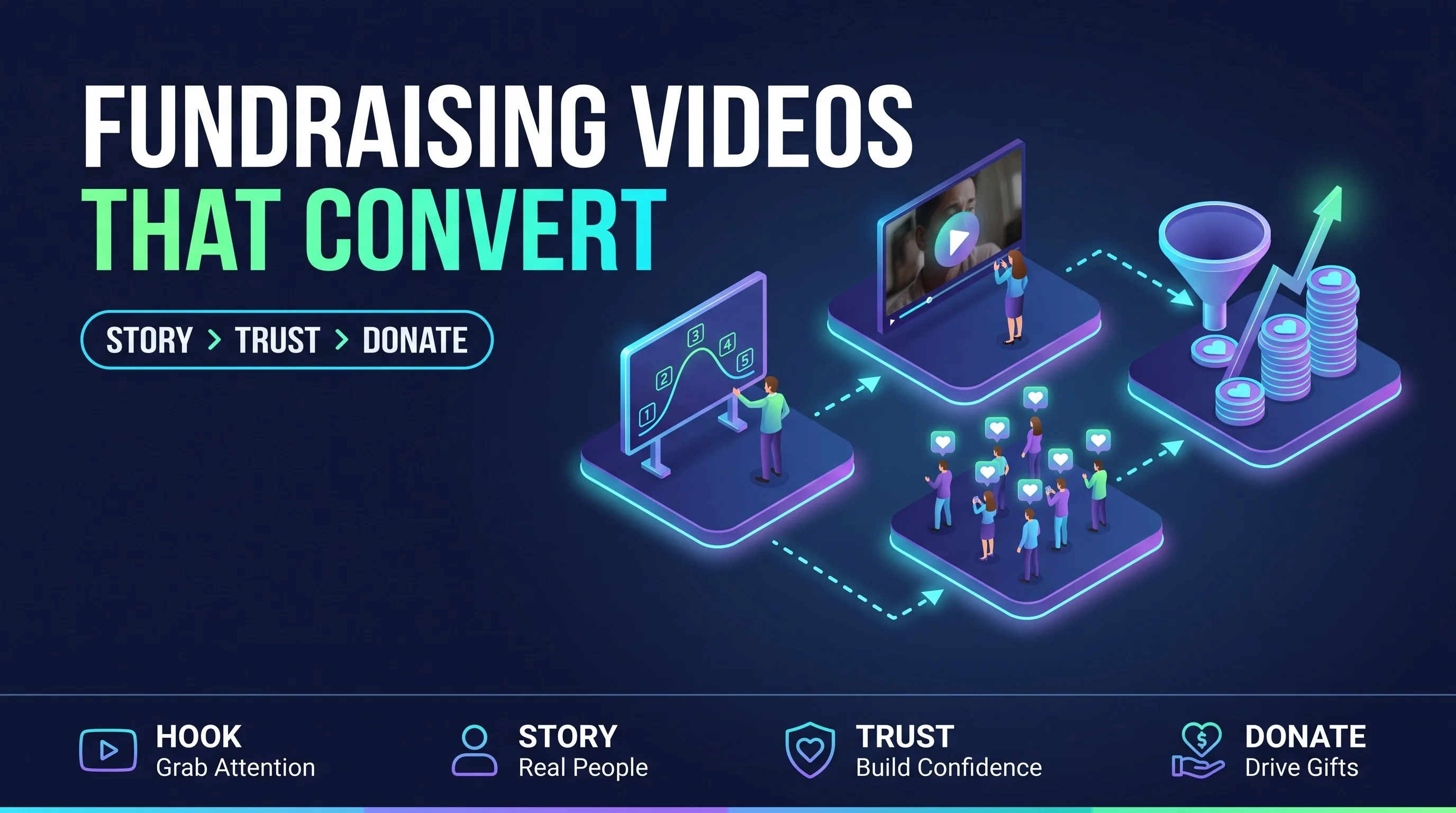
A fundraising video works like a piece of machinery: a story arc, a timed ask, and production choices that either earn donor trust or quietly cost you some. At Tidal Media Co., every fundraising video we build starts from that assumption.
The videos that convert follow a five-part arc: hook, protagonist, conflict, transformation, ask. Skip a piece and the next one loses its footing. A transformation means nothing without real conflict behind it, and conflict stays abstract without a protagonist the viewer can picture.
The first three seconds decide whether anyone watches past the hook. A real face, a specific question, an unexpected image hold attention better than a title card or a logo. The bar is simple: make the viewer feel like they're about to meet someone real.
The hero should be one identifiable person. "Millions of children go without meals tonight" is a fact that registers and fades. One child, named, shown in a real home, facing a specific problem, creates tension a statistic can't. The beneficiary carries the story's emotional weight. Your organization just builds the bridge to them.
The before-and-after moment is where a donor decides whether giving changes something real. It should be specific and believable enough to picture: a kid eating three meals a day now instead of one, a family in stable housing, a student who graduated. That specificity is what makes the ask land, because the viewer just watched proof the model works.
Time the ask to that moment, right after the transformation, while the emotional charge is still there. An ask tacked onto the last five seconds after the energy has dropped does less work than one that shows up while the viewer is still leaning in. On longer videos, repeating the ask at a couple of points beats saving it for one shot at the end.
Donors respond to specific detail. A child's name, a neighborhood, the number of meals served, an exact before-and-after moment they can picture. Details like that signal truth, and truth signals a donation will produce a real result. A vague appeal to "millions of people suffering" keeps the viewer at a distance. One specific story pulls them in and holds them through the ask.
Authenticity works the same way. Shoot in the space where the work happens. Let people talk in their own words rather than reciting a line. Viewers pick up on these cues almost without noticing: does this look like where the work happens, does this person sound real, are the relationships on screen genuine. Get those right and donor trust goes up. Miss one and something feels off, even if the viewer can't say exactly what.
That 560% lift from earlier came down to one variable: how the ask was delivered. The call to action carries more weight than most nonprofits give it credit for. It's the engineering decision that determines whether the emotional momentum you built converts into a gift or evaporates the second the screen goes dark.
The formula that outperforms vague alternatives: a strong verb, a specific impact, urgency. "Donate $25 to provide meals tonight" gives a donor a clear, consequential action. "Click here to help" gives them an open-ended gesture, and open-ended gestures are easy to scroll past.
Put the CTA on screen. A large share of your audience watches muted, and a CTA that only lives in the narration reaches none of them.
The landing page has to honor whatever the video just earned. A high-contrast button above the fold, room to breathe around it, a tap target big enough to hit on a phone. Call these conversion mechanics, because a strong video paired with a weak landing page is where most nonprofits lose the gift they already earned.
Donors don't need cinema. They need credibility, and there's a real gap between production minimums that build trust and production extras that don't move the needle. Plenty of strong fundraising videos get shot on a phone. The camera matters less than the story, the audio, and the framing.
Audio is the one thing you can't fake. Clean dialogue with a shaky frame beats sharp 4K footage with distracting background noise, every time. If the budget is tight, an external mic is the first upgrade worth making, a wireless lav in the sub-$100 range gets you most of the way there. After that, natural light, a stable surface for the camera, and one clean location cover most of what separates a credible video from one that loses donor trust before the story even lands.
Budget ranges vary a lot by scope. A DIY shoot with a solo videographer runs under $2,500. A small crew with a full shoot day and real post-production lands somewhere between $2,500 and $8,000. A multi-day shoot across locations with sound design and a distribution plan moves into $8,000 to $20,000 territory. If money is tight, put it into audio first, then into an editor who understands donor psychology as much as video polish.
A great video posted in the wrong format on the wrong platform is a wasted shoot. The efficient move is one master cut, sliced into a version built for each platform, so each audience gets the video in the shape they're likely to watch to completion.
TikTok and Reels want vertical video, fifteen to sixty seconds, a fast hook in the first two seconds, captions on. Facebook feed does better with a square or near-square crop and a slightly longer runtime, thirty to sixty seconds. Email works best as a thumbnail with a play button linking out to the full video on a landing page. YouTube is where the full narrative arc belongs: two to five minutes, horizontal, the complete story.
Retention predicts conversion more than view count does. A thirty-second video watched to ninety percent beats a three-minute video watched to twenty percent, because viewers who drop off before the transformation and the ask never reach the point where giving feels like the obvious next step. Track average view duration and completion rate next to click-through on the CTA. Together those three numbers tell you whether the weak point is the hook, the story, the ask, or the landing page.
The framework holds together end to end: a five-part story arc built on specific and authentic detail, a CTA that's timed and engineered instead of tacked on, cut for whatever platform it lands on. Budget rarely decides which videos raise money. Structure does.
We build this exact structure for nonprofits across Southern California, from the first outline through the final cut. Check out our case studies to see it in practice, or reach out and we'll map out what it looks like for your next campaign.
We plan, shoot, and edit fundraising videos for nonprofits across Southern California, structure first, then production.
Book a Call