Most businesses treat video like a branding expense. They budget for production, film something that looks sharp, post it once on Instagram or the homepage, then wait. Leads don't show up. The footage gets buried under "awareness," which just means nobody measured it.
The real gap is that nobody built the video into a system. Every project we run starts with the same question: where does this specific piece sit in the buyer's funnel, and what action is it supposed to drive? That question changes how the whole piece gets built. Each video gets a defined job, a place to live, and a way to track whether it worked.
Here's the system we run: a funnel built around format, a placement strategy, rules for CTAs and capture, and a way to measure what's working.
Video tends to run at a higher cost per lead than a cold form fill or a basic email capture, and that gap makes sense once you look at what the lead represents. A viewer who watches most of a two-minute video already sat through your problem framing, your process, your proof, before ever raising their hand. A cold form fill tells you almost nothing about intent.
Blended B2B cost-per-lead runs around $200 on average across channels, with wide swings by industry and deal size. Video can land above or below that depending on the platform. What matters more is what happens after the lead comes in. Someone who spent two minutes with your business before the phone rang shows up differently in your show rates and your close rates than someone who filled out a generic form.
Publishing the wrong format at the wrong stage is one of the most common reasons a video strategy underperforms, and it rarely shows up in the reporting. Views and impressions still look fine. Bookings just don't follow.
At the top of the funnel, the job is building a pool of people who know who you are and what problem you solve. A short 60 to 90 second piece built for social reach handles that without asking for anything yet.
In the middle, webinars and demos carry the weight. A live session converts attendees at roughly three times the rate of an on-demand replay, because the registration step filters for people who are already leaning in. A product demo does similar work for buyers who already know they have the problem and are comparing options.
At the bottom, testimonials and case studies confirm a decision that's already close to made. A testimonial sitting alone on an About page with no next step wastes the asset. Pair it with a direct booking link and it earns its place.
A landing page built around one offer needs a short, direct video with a clear CTA and a simple form. A service page can carry something longer, since the visitor is already further into evaluating you. The same testimonial performs differently depending on where it sits. On a service page it builds trust in context. Dropped into a follow-up email, it closes a loop that's already open.
Paid distribution extends the reach of whatever you've built. A retargeting audience that already watched a chunk of your top-of-funnel piece is a far warmer group to serve a case study or demo to than a cold audience starting from zero.
One of the most underused placements is inside your follow-up sequence. A short video sent right after someone books, one that walks through what to expect on the call, raises show rates more than a text-only reminder usually does. Most businesses collect the email and send a plain drip sequence. One well-placed video in that sequence changes the outcome.
This is where most video lead gen setups fail, and nobody notices until the pipeline looks thin. The mechanics of the ask decide whether a viewer becomes a lead or just closes the tab.
Placement matters. A soft mention early signals what's coming without demanding anything yet. A CTA that lands after you've delivered real value earns a much better response than one that opens with the ask before you've proven anything. Put the CTA on screen, not just in the audio. A large share of your social audience watches with the sound off, and a CTA that only exists in narration reaches none of them.
Gate after the viewer has seen enough to want more, not before. Asking for an email before anyone's seen a shred of proof shrinks your audience down to almost nothing, and the few who convert often aren't the buyers you wanted. Ask for a name and email first. Layer in company size or service interest later, once someone's shown real interest.
Test your gate placement, your CTA wording, your form length. Just don't grade the test on click-through rate alone. A click tells you someone was curious. It doesn't tell you they showed up, or that they turned into a client. Judge the test on what happened downstream.
Most video vendors hand over files and move on. The footage goes up, engagement is thin, and nobody can say why. Every project we run works differently. Strategy, scripting, production, paid distribution, and the results all feed back into next month's plan. That loop is what turns a video into a system, and it's the same structure behind the Tidal Video Framework.
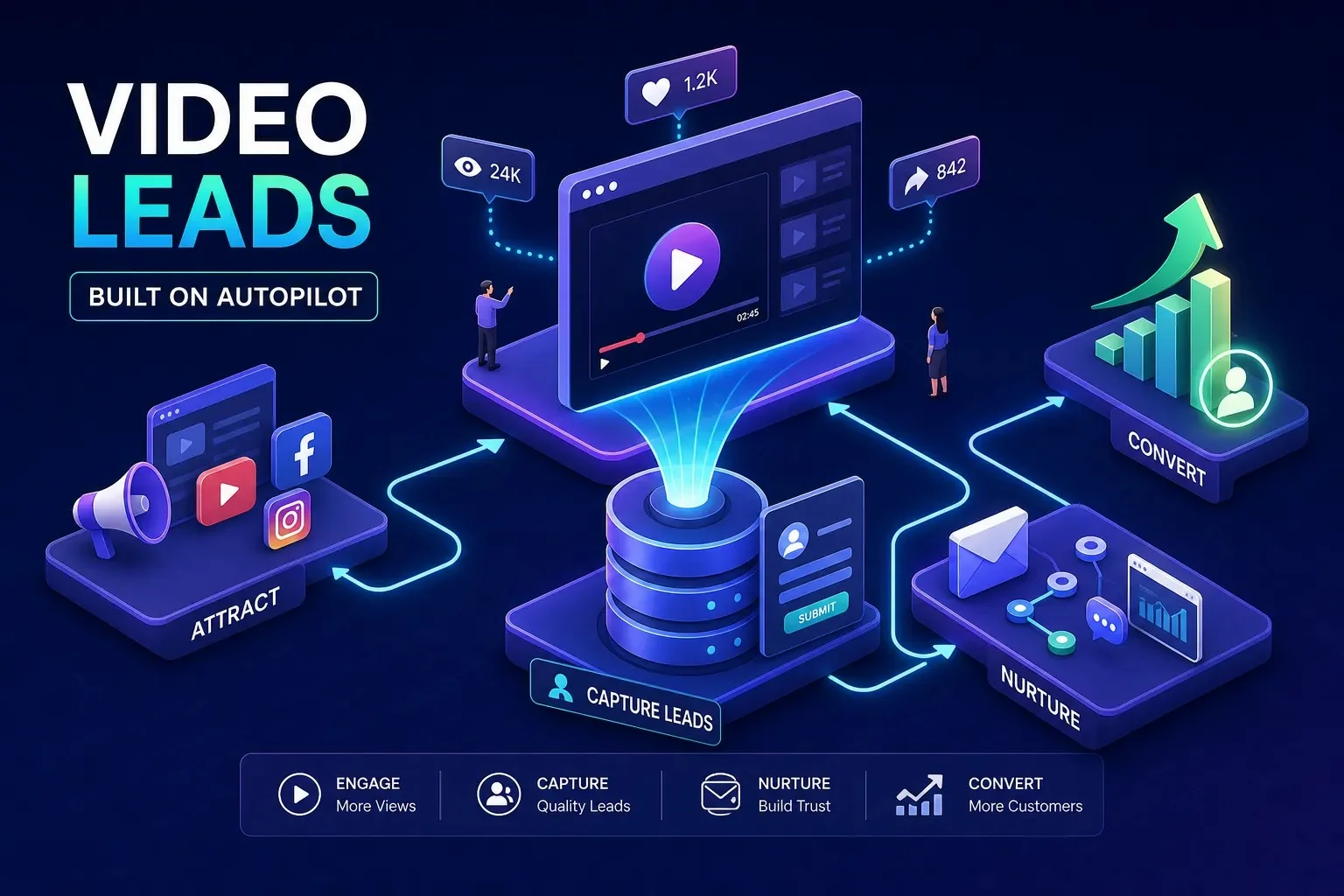
A working funnel looks like this in practice. A short educational video runs on paid social to build initial reach. Anyone who watches most of it gets served a case study or demo next. That warm audience lands on a page built around one offer, with a short video and a simple booking form. Once they book, a short follow-up video in the email sequence gets them ready for the call. Pull one piece out and the rest loses its footing: the awareness video builds the pool, the retargeting piece warms it, the landing page captures it, the follow-up gets them to show up.
If your video isn't generating leads right now, the gap is usually one of four things: the format doesn't match the funnel stage it's sitting in, the CTA is weak or shows up too early, there's no real capture mechanism, or nobody's tracking what happens after the view. Find which one it is and fix that piece before you shoot anything new.
We build this exact system for clients every month. Check out our case studies to see it in practice, or reach out and we'll map out what it looks like for your business.
We build and manage this exact system for clients every month, strategy, production, and distribution included.
Book a Call